Deborah Meadows
Itinerant Men
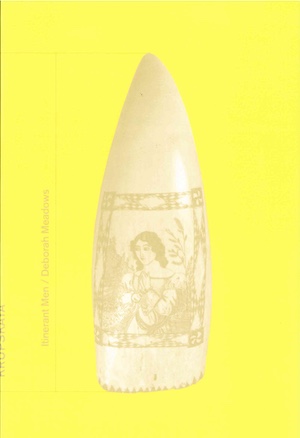
ISBN 1-928650-21-x
$13.00
96 pages
“For hate’s sake I spit my last breath at thee!” Ahab cries to the whale, in Herman Melville’s 1851 novel of the sea and social relations. Thinking of the 19th century as a jumble of contradictions—free social experiment and slavery, revolution and charisma, rational enquiry and racist construction—Deborah Meadows has written a book that takes Moby-Dick one chapter at a time and performs a reading-through of the novel that combines chance operation with philosophical investigation.
Father Mapple recasts the story of Jonah as a prescient allegory of sovereignty: “… And if we obey God, we must disobey ourselves; and it is in this disobeying ourselves, wherein the hardness of obeying God consists.” Now under weigh, can Itinerant Men recast self and world by rejecting bogus authority? Is self a reliable stick or stone at the barricades? Is the writer a kind of negated self and thus possibly immune from divine disappointment? Or, in line with Rabelais, can excess counteract the pull of compelling language that inspires one to ends greater than the dollar? Is value a scale under erasure? Language a cobbled beast?
In Itinerant Men various words, phrases, and extended quotations are from Moby-Dick or, The Whale by Herman Melville—the Penguin edition of 1992.
“Penetrating further and further into the heart of the Japanese cruising ground, the Pequod was soon all astir in the fishery. Often, in mild, pleasant weather, for twelve, fifteen, eighteen, and twenty hours on the stretch, they were engaged in the boats, steadily pulling, or sailing, or paddling after the whales, or for an interlude of sixty or seventy minutes calmly awaiting their uprising; though with but small success for their pains.
“At such times, under an abated sun; afloat all day upon smooth, slow heaving swells; seated in his boat, light as a birch canoe; and so sociably mixing with the soft waves themselves, that like hearthstone cats they purr against the gunwale; these are the times of dreamy quietude, when beholding the tranquil beauty and brilliancy of the ocean’s skin, one forgets the tiger heart that pants beneath it; and would not willingly remember, that this velvet paw but conceals a remorseless fang.”